

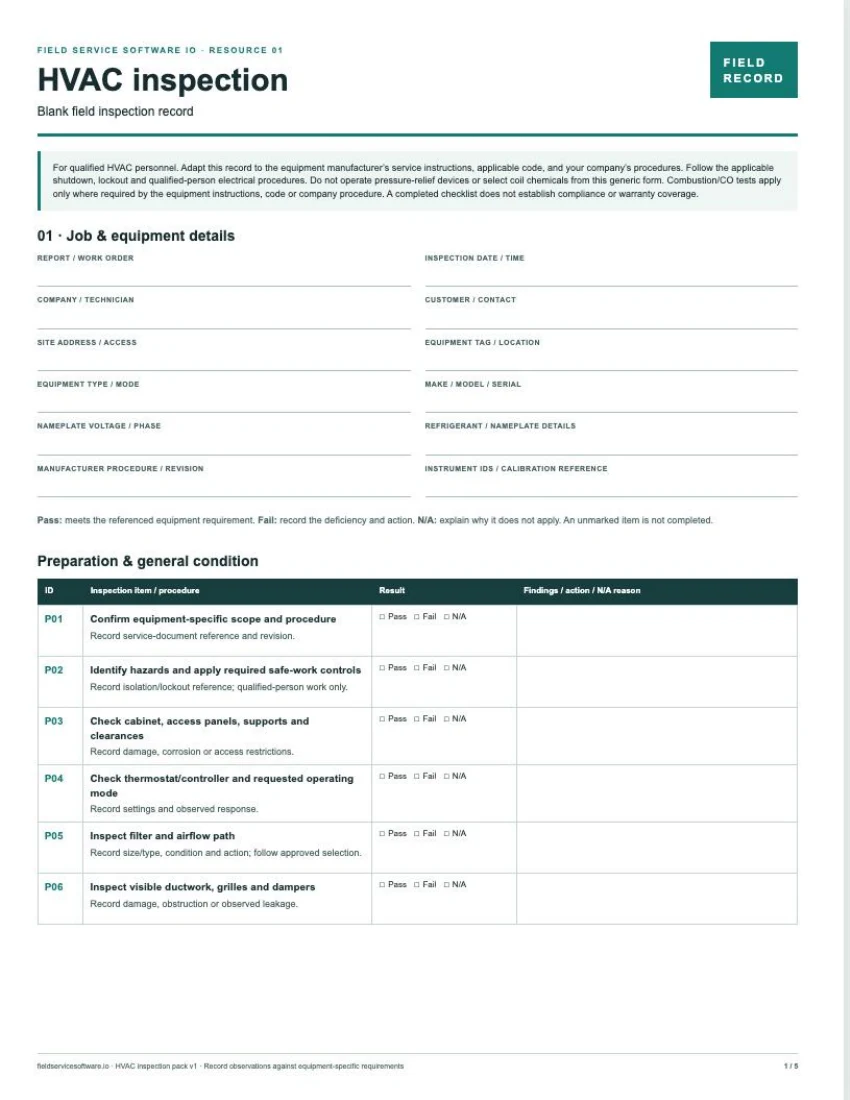
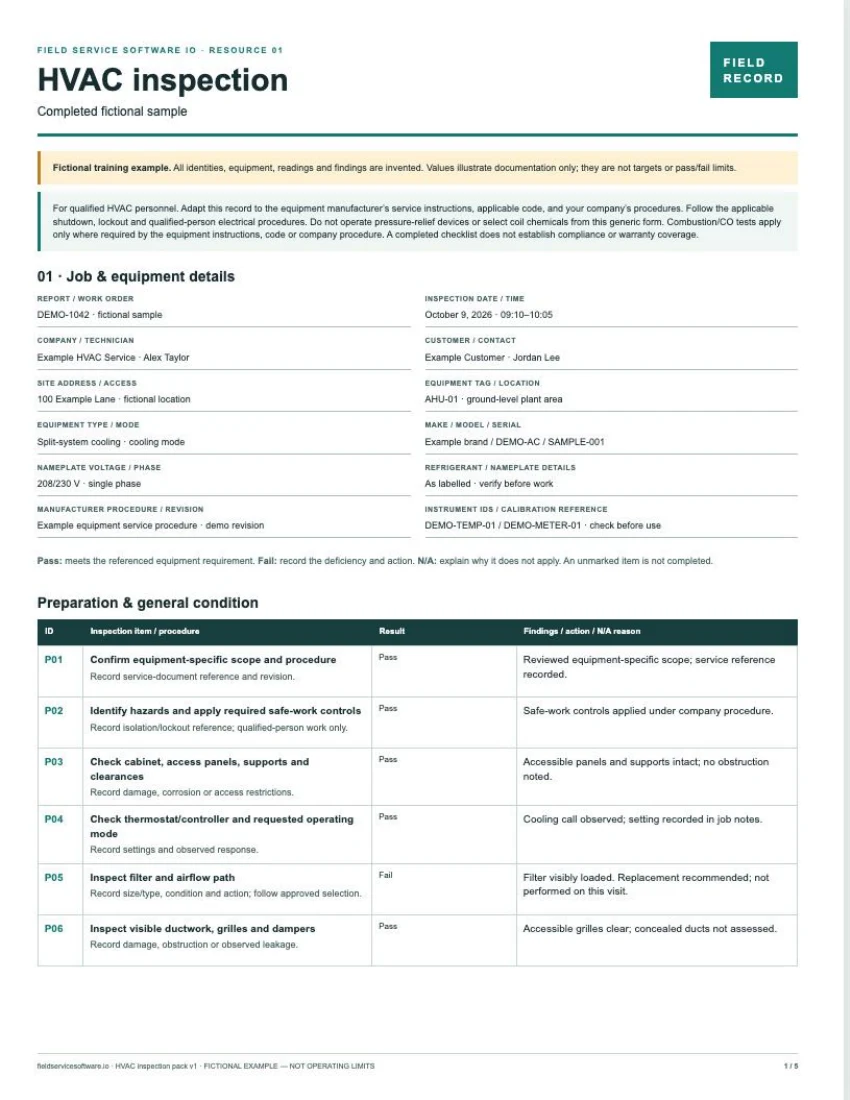
Quick answer: use paper as a starting point, not a system
Use a printable HVAC inspection checklist when the immediate goal is to make every tune-up or maintenance visit repeatable. A paper form is inexpensive, easy to hand to a new technician, and dependable when a device, battery, or connection is unavailable. Its limitation is what happens after the visit: the office still has to file it, find it later, and re-enter any follow-up work.
Digital field-service platforms can turn the same inspection steps into a connected workflow. ServiceTitan supports assigning digital forms and checklists to jobs, customers, locations, or equipment. Jobber offers customizable job forms for technicians to complete during visits, while FieldEdge lists HVAC among the industries it serves. The right choice is operational: keep a printable version for simple or offline work; consider a digital form when the selected platform’s documented record storage, field attachments, dispatch follow-up, and reporting capabilities matter more than the convenience of a clipboard.
Key Takeaways
- Printable checklists make required inspection steps visible and support a consistent process
- Different HVAC systems require specialized checklists covering electrical, mechanical, and safety components
- Digital integration with mobile apps creates shareable records while maintaining the simplicity of paper templates
What Is a Printable HVAC Inspection Checklist Template?
A printable HVAC inspection checklist template is a standardized document that helps technicians systematically evaluate heating, ventilation, and air conditioning systems.
These templates structure inspections while ensuring nothing gets missed during the process.
Purpose and Benefits
HVAC inspection checklists serve as structured guides for ensuring systems function efficiently and safely. They catch potential problems before they develop into larger failures.
The main benefits are preventing costly breakdowns and maintaining consistent service quality across your team. With a structured checklist, technicians follow the same steps in the same order — skipping a component becomes visible rather than easy.
These templates also create documentation that builds customer trust. A thorough inspection report shows customers what was evaluated and what was found.
Key advantages:
- Consistency – Makes the selected inspection steps visible on every visit
- Efficiency – Reduces inspection time while improving thoroughness
- Documentation – Creates records for compliance and customer communication
- Training – Helps new technicians learn proper inspection procedures
Common Components Included
Most printable HVAC inspection checklist templates cover the same essential system components.
Electrical Systems:
- Wiring connections and controls
- Voltage verification
- Thermostat operation
Mechanical Components:
- Blower assembly and motor
- Heat exchangers and coils
- Refrigerant lines and pressure
Safety Elements:
- Gas line inspections
- Carbon-monoxide or combustion checks when required by the equipment procedure, applicable code, or company program
- Pressure-relief-device inspection or testing when required by the equipment procedure or applicable code
The template format typically uses checkboxes for each item, making it easy to mark completed tasks and identify areas needing attention or repair work.
Types: Residential vs. Commercial
Residential templates focus on single-family home systems with simpler components. These typically cover basic furnaces, air conditioners, and ductwork.
Commercial templates are more complex — multiple units, advanced controls, and specialized equipment like boilers or chillers.
- Residential systems: Often one thermostat and fewer zones, with documentation sized to the equipment and service scope.
- Commercial systems: May include multiple zones, building controls, larger or specialized equipment, and additional documentation or compliance requirements.
Inspection depth varies accordingly. Residential visits are often simpler, while commercial inspections can require more time because of facility size, multiple units, and additional controls.
Core Elements of a Comprehensive HVAC Inspection Checklist
Every effective HVAC inspection checklist requires three foundational components: proper system documentation that captures equipment specifications and service history, mandatory safety procedures that protect technicians and occupants, and thorough condition assessments that identify current performance levels and potential issues.
System Documentation and Details
Start inspections by recording essential system information — equipment model numbers, serial numbers, installation dates, and manufacturer specifications.
The documentation section should capture refrigerant types and charge levels, recording current operating pressures against manufacturer baselines.
Equipment Details to Document:
- Unit make, model, and serial number
- Installation date and warranty information
- Previous service history and repairs
- Current refrigerant levels and type
- Electrical specifications and voltage requirements
Filter information deserves specific attention: filter types, sizes, and replacement dates help establish maintenance patterns.
System capacity ratings matter for proper operation. Document BTU ratings, tonnage, and energy efficiency ratings — these become useful when diagnosing performance issues later.
Thermostat settings and programming schedules round out the documentation: current temperature settings, scheduling programs, and any custom configurations.
Critical Safety Procedures
Safety checks form the backbone of any HVAC inspection checklist, but this template is a planning aid rather than a work authorization. Gas-side service, refrigerant-circuit work, pressure-relief-device operation, and electrical panel or motor diagnostics belong only to personnel whose qualifications, certifications, and authorization meet the equipment instructions, employer safety program, and applicable law. Identify required safety switches and controls here; test them only under the procedure that applies to the specific equipment.
For gas-fired equipment, determine whether and how to perform carbon-monoxide or combustion testing from the applicable code, the equipment manufacturer’s service instructions, and company safety procedures. A current Carrier gas-fired equipment manual, for example, says installation and service must be performed by qualified personnel and directs users to follow the unit instructions. When testing is required, use the procedure and instrumentation those requirements specify; a generic checklist is not a substitute.
For electrical work, OSHA 1910.333 requires exposed live parts to be deenergized before work unless deenergizing creates an additional hazard or energized testing is infeasible. Deenergized equipment must follow the required lockout/tagout and verification procedure. Any necessary energized voltage or amp-draw testing must be performed by a qualified person using the work practices and protective equipment appropriate to the hazard.
Safety items to include when applicable:
- Electrical connections for loose or damaged wires after the equipment is placed in the required safe state
- Gas line and valve checks assigned by the equipment instructions and applicable procedure
- Pressure-relief-device inspection or testing required by the equipment manufacturer and applicable code
- Limit switches and safety controls
- Proper venting and combustion air supply
Before inspecting exposed electrical panels, connections, or motor components, follow the required deenergizing, lockout/tagout, stored-energy, and verification steps. Do not describe an electrical circuit as deenergized merely because a control or disconnect appears off.
Refrigerant work must follow the applicable EPA rules and the equipment procedure. EPA requires Section 608 certification for technicians who maintain, service, repair, or dispose of equipment in ways that could release regulated refrigerants. A qualified technician should select the leak-inspection or testing method appropriate to the system rather than applying one method to every connection.
Document the location and condition of emergency shutoffs. Operate a gas valve, electrical disconnect, or emergency stop only when the applicable procedure calls for it and the qualified person has controlled the consequences of shutdown and restart.
General Condition Assessment
Physical condition assessment reveals system health and remaining lifespan. Examine all visible components for wear, corrosion, and damage.
Where accessible under the equipment procedure, qualified gas-service personnel inspect heat exchangers for conditions such as cracks or corrosion that may require further diagnosis.
Condition Assessment Areas:
- Coil cleanliness and fin damage
- Belt wear and proper tension
- Motor bearing condition and lubrication
- Ductwork integrity and insulation
- Control panel cleanliness and functionality
Air filter condition directly impacts system performance — check for dirt accumulation, proper fit, and airflow restriction.
Visible refrigerant lines can be inspected for insulation damage and mechanical wear without disturbing the circuit. Oil residue may indicate a leak and should be evaluated under the applicable refrigerant-service procedure.
The outdoor unit requires assessment for physical damage, debris accumulation, and proper clearances. Confirm the unit sits level and has adequate airflow space.
Detailed Checklist Sections and Key Inspection Tasks
The most effective HVAC inspection templates organize into three core areas that catch the majority of system failures — covering the components that determine whether heating and cooling systems operate safely and efficiently.
Air Conditioning System Evaluation
For equipment that has an outdoor condensing unit, inspect it for visible damage or debris buildup. Inspect the condenser coil and clean it only when indicated, using the method and materials permitted by the equipment manufacturer.
Filter Assessment:
- Check air filters for dust accumulation
- Note filter type and replacement needs
- Inspect for ice buildup or moisture damage
The evaporator coil inspection comes next — look for corrosion, leaks, or excessive dirt that may restrict airflow or heat transfer. If cleaning is indicated, use the equipment manufacturer’s approved method and product for that coil; Trane’s current evaporator-coil guidance begins with inspection and limits chemical cleaner to an approved product when the coil has accumulated oil or grease.
Observe blower motor operation for speed or unusual noise only when the equipment can be operated safely under the applicable procedure.
When relevant to the equipment and service scope, a qualified technician may record superheat, subcooling, or other manufacturer-specified readings. Visually inspect accessible refrigerant lines for damage without opening or disturbing the circuit.
The condensate drain pan and drain line need examination for clogs or overflow issues.
Inspect accessible electrical connections for looseness or corrosion only after completing the required deenergizing and verification procedure. Any energized voltage measurement is a separate qualified-person task governed by the electrical safety gate above.
Static pressure readings on supply and return air help identify ductwork problems.
Heating System Review
Gas furnace inspections require careful attention to safety components. Listen for excessive noise or vibration during operation.
Inspect a heat exchanger only under the equipment procedure and with the required qualifications and tools. Record visible corrosion, damage, or other conditions that require qualified diagnosis; do not treat a generic checklist as a diagnostic finding or a carbon-monoxide test.
Critical Safety Checks:
- Perform required carbon-monoxide or combustion testing using the applicable procedure
- Inspect ignitor and flame-sensor condition as the equipment procedure permits
- Test required safety controls using the manufacturer-specified sequence
- Complete gas piping and valve checks assigned by the applicable gas-service procedure
The venting system requires inspection of connector pipes for secure fastening and support. Check ductwork for damage and moisture accumulation that reduces efficiency.
For electric furnaces, qualified personnel may inspect heat strips for corrosion, pitting, or burns after the required safe-state procedure. Continuity checks are performed deenergized; any energized amp-draw measurement is performed only when necessary under the qualified-person electrical procedure. Test sequencers, limit switches, and fuses only as the equipment service instructions specify.
Water heater inspection may include visible checks for rust, leaks, temperature settings, venting, and relief-device condition. Do not operate a pressure-relief valve merely because it appears on a generic checklist; follow the water heater manufacturer’s instructions, applicable code, and site procedure, using qualified personnel where required.
Electrical Component Inspection
Every HVAC system depends on proper electrical operation. After completing the required deenergizing and verification procedure, a qualified person can inspect accessible wiring and connections for looseness, corrosion, damage, or signs of overheating.
Functional testing may cover heating and cooling calls, temperature sensors, and programming when the equipment can be operated safely. Clean or inspect inside control panels only in the safe state required by the electrical procedure; energized diagnostic work remains limited to qualified persons.
When the equipment instructions call for it, a qualified person may take an energized motor amp-draw measurement under the required energized-work controls. Perform lubrication, belt-tension, and hands-on motor checks only after controlling electrical and mechanical stored energy.
Electrical-panel inspection, fuse evaluation, and disconnect testing must follow the qualified-person, deenergizing, lockout/tagout, and energized-testing rules above.
Potential measurement points for a qualified person, when required:
- Main electrical panel connections
- Individual component voltage requirements
- Control circuit low voltage operation
- Safety switch and sensor operation
Inspect accessible wiring from the thermostat to outdoor equipment only in the safe state required for the task. Record visible damaged insulation or suspect connections for qualified evaluation rather than reaching into exposed energized equipment.
Record the equipment’s marked electrical ratings and verify the actual supply before testing. OSHA requires electrical appliances to carry accessible nameplate ratings, and current Carrier product literature shows both single-phase and three-phase supply configurations. The building type alone does not identify the phase.
Preventive Maintenance and Energy Efficiency
Regular maintenance schedules reduce energy consumption while extending equipment life. Proper timing and targeted improvements deliver measurable cost savings and healthier indoor environments.
Schedule and Frequency Recommendations
Set inspection frequency according to the equipment manufacturer, the system’s condition and usage, local requirements, and the customer’s maintenance agreement. A recurring schedule is a starting point, not a substitute for those requirements.
Recurring Tasks (as applicable):
- Replace or clean air filters
- Check thermostat settings
- Inspect visible components for damage
Periodic Tasks (as applicable):
- Clean coils and drain lines
- Test safety controls
- Measure refrigerant levels
- Lubricate moving parts
Seasonal or Annual Tasks (as applicable):
- Complete system tune-up
- Ductwork inspection
- Electrical connection testing
- Calibrate controls
Commercial buildings may need a more frequent or more detailed program because of higher usage, multiple zones, and compliance obligations. Set the cadence by equipment, occupancy, operating conditions, and applicable requirements.
Using an HVAC preventive maintenance checklist keeps technicians consistent across all visits. Digital templates make scheduling automatic and track completion rates.
Energy Savings Opportunities
Preventive maintenance directly impacts energy bills through improved efficiency. Clean coils transfer heat better, requiring less power to reach target temperatures.
Key efficiency levers:
- Clean filters: Support proper airflow
- Coil cleaning: Restore heat transfer when coils are dirty
- Correct refrigerant charge: Helps the system operate within manufacturer specifications
- Calibrated thermostats: Eliminate temperature swings
Ductwork leaks can waste conditioned air. Diagnose the source of loss and follow applicable installation requirements before recommending sealing work.
Modern diagnostic tools help identify problems before they become expensive. Infrared cameras spot hot electrical connections. Pressure gauges detect refrigerant issues early.
Indoor Air Quality and Health Impacts
Poor maintenance can affect productivity and comfort. Dirty filters may allow more dust and other airborne particles to circulate through a building.
Health Impacts of Poor Maintenance:
- Respiratory irritation for sensitive occupants
- Mold growth in wet drain pans
- Odors from overheated components
- Reduced comfort or productivity
Clean, properly operating systems help support indoor air quality and humidity control, but the appropriate target depends on the building, climate, and occupants.
Filter replacement deserves close attention. Select the filter type and replacement interval according to the equipment manufacturer, system design, and indoor-air-quality needs.
Coil and drain-pan maintenance can limit conditions that contribute to buildup and odors. Evaluate UV equipment against the system design, maintenance plan, and the claims supported by its manufacturer.
For combustion equipment, include carbon-monoxide or combustion testing only when the equipment instructions, applicable code, or company safety procedure calls for it; those sources determine the method and cadence.
Digital Vs. Printable Checklists and Integration with HVAC Software
Digital checklists can reduce paper handling while enabling field data capture and customer sharing. The available inspection, signature, offline, and sharing features depend on the selected platform and configuration.
Advantages of Digital Checklists
Paper forms get lost, damaged, or left in trucks. Digital HVAC inspection checklists solve these problems and offer customization options paper can’t match.
Depending on the platform and connection, digital forms can sync across devices, letting technicians continue an inspection on another approved device. Completed records are easier to find when teams use a consistent filing and retention process.
Key digital advantages:
- Real-time editing – Multiple techs can update the same checklist
- Photo integration – Attach images directly to specific inspection items
- Centralized records – Store completed work in the selected system of record
- Weather resistance – Tablets work in conditions that destroy paper
The customization factor matters: different templates for residential heat pumps versus commercial units can reflect the equipment being serviced. Confirm offline availability, sync behavior, and device requirements before relying on a platform in areas with poor connectivity.
E-signatures and Documentation
Digital signatures let customers acknowledge completed checklists on a tablet immediately after service. Their legal effect depends on the jurisdiction, consent process, and record controls used by the business.
E-signature benefits:
- Documented acknowledgement – Record a customer’s sign-off alongside the completed checklist
- Configurable delivery – Email or share a completed form when the selected platform supports it
- Audit trails – A platform may retain timestamps and other record details
- Clearer communication – Complete documentation can reduce misunderstandings
Digital photos attach directly to inspection line items. When a cracked heat exchanger shows up, the image links to that specific checklist entry. Customers receive professional-looking reports on the spot rather than waiting for paperwork.
Integration with Business Operations
Modern HVAC software can connect inspection checklists to other business functions. Depending on the platform and configuration, a completed checklist can prompt a follow-up appointment, a quote, or the next billing step.
When CRM and inspection records are connected, customer information, equipment details, and service history may populate the form and reduce duplicate entry.
Integration capabilities:
- Inventory tracking – Flag parts that need replacement during inspections
- Scheduling automation – Book maintenance appointments based on inspection findings
- Customer communication – Send automated follow-up emails with inspection results
- Revenue optimization – Identify upselling opportunities from inspection data
Reporting can reveal patterns that are difficult to see in paper files, such as recurring issues by equipment type or inspection results by technician. Billing integrations can use completed inspection data in the invoicing workflow when configured for that purpose.
Best Practices for HVAC Technicians and Contractors
Systematic inspection practices separate contractors with consistent service quality from those dealing with recurring callbacks. Proper checklist implementation, customization protocols, and clear client communication drive measurable improvements.
Using Checklists to Enhance Service Quality
Use the appropriate inspection checklist for each applicable service call. It makes required components visible and creates a consistent service standard across the team.
Digital vs. Paper Implementation:
- Mobile apps allow real-time completion tracking
- Paper forms work in areas with poor connectivity
- Hybrid systems provide maximum flexibility
Structured HVAC inspection checklists can help technicians document potential issues consistently. Those findings give the team a clearer basis for recommendations, quotes, and customer conversations.
The key is making checklist completion mandatory, not optional. Checklists work better when technicians view them as professional tools that support their expertise rather than question it.
Checklist Customization and Supervisor Review
Customize HVAC maintenance checklist templates based on specific equipment types and manufacturer requirements. Generic checklists miss critical components unique to different systems.
Equipment-Specific Modifications:
- Gas furnaces require the combustion-safety checks and any carbon-monoxide testing specified by the manufacturer, applicable code, and company procedure
- Heat pumps need defrost cycle verification steps
- Mini-splits demand refrigerant line inspection procedures
Prompt supervisor review of completed checklists can surface recurring issues and identify training opportunities for individual technicians.
Review preventive-maintenance checklists regularly and whenever equipment, regulations, manufacturer guidance, or company procedures change.
Compliance and Client Communication
Accurate, completed records may support audits or warranty claims only when applicable code, manufacturer, employer, retention, and procedural requirements are met. A checklist alone does not establish compliance, warranty coverage, or immunity from liability.
Client Communication Strategy:
- Share completed checklists with homeowners immediately
- Highlight completed tasks and identified issues
- Provide clear recommendations with priority levels
A detailed inspection report can give homeowners a clearer record of the work performed and the findings that support a recommendation. The checklist is documentation, not by itself proof that a condition has been fully diagnosed.
Photographing critical components during inspections and attaching images to digital checklists helps homeowners understand recommended repairs and creates clear records for future reference.
Related Templates and Resources
- HVAC Equipment Schedule Template — the equipment records an inspection checklist references
- HVAC Invoice Template — invoice repairs identified during an inspection
- Free Commercial HVAC Maintenance Contract Template — the agreement that schedules recurring inspections
- The best HVAC field service software — platforms that digitize inspection checklists and scheduling
Correction note
July 23, 2026: We corrected the safety and maintenance guidance to avoid treating carbon-monoxide testing as universal for gas equipment, prescribing pressure-relief-device inspection or operation from a generic checklist, assuming three-phase power for commercial equipment, or prescribing chemical evaporator-coil treatment for every unit. We also clarified that accurate completed records may support audits or warranty claims only when applicable code, manufacturer, employer, retention, and procedural requirements are met; a checklist alone does not establish compliance, warranty coverage, or immunity from liability. The checklist now directs technicians to the equipment manufacturer’s instructions, applicable code, and qualified-person procedures for those decisions, including electrical work.